
Written by Eugene Nyarko Jnr. | Alisa Hotel, Accra | Wednesday, August 26, 2026
Ghana must consolidate its recent macroeconomic gains and translate economic stability into quality jobs, stronger investment and inclusive development, the Ministry of Finance has said.
The Ministry said the country’s economic recovery had created a stronger foundation for growth, but stressed that sustained implementation of reforms would be critical to turning the recovery into long-term economic transformation.
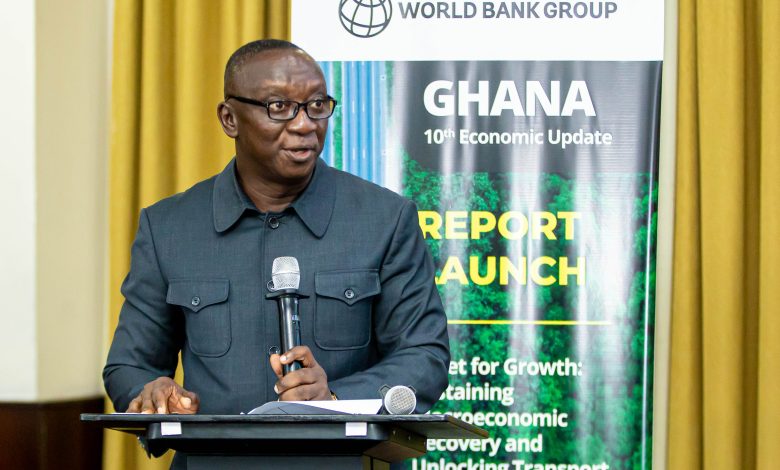
The Coordinating Director at the Ministry of Finance, Samuel D. Arkhurst, made the statement on behalf of the Minister of Finance, Dr Cassiel Ato Baah Forson, at the launch of the 10th Ghana Economic Update in Accra on Wednesday.
The World Bank’s latest report, titled “Reset for Growth: Sustaining Macroeconomic Recovery and Unlocking Transport for Transformation,” examines Ghana’s economic recovery and highlights the importance of transport infrastructure and reforms in supporting growth.
Mr Arkhurst said the theme of the report closely aligned with the government’s 2026 Budget theme, “Resetting for Growth, Jobs and Economic Transformation.”
He said the alignment reflected a shared understanding between the government and the World Bank on Ghana’s economic challenges and the need to sustain reforms to achieve inclusive growth.
Recovery built on difficult choices
According to the Ministry, Ghana’s economic recovery had been underpinned by difficult policy choices, with recent indicators showing significant improvements in macroeconomic stability.
Mr Arkhurst said inflation had fallen from 23.8 per cent in December 2024 to 4.6 per cent at the end of July 2026, placing it comfortably within the government’s target band.
He also said real Gross Domestic Product (GDP) grew by 6.4 per cent in the first quarter of 2026, exceeding the government’s full-year projection.
Gross international reserves, he added, now covered five months of imports.
Another significant development, he said, was the improvement in Ghana’s debt sustainability outlook, with the joint IMF-World Bank Debt Sustainability Analysis upgrading the country’s debt risk rating to moderate.
He described the development as particularly significant because it represented the first time since April 2014 that Ghana’s external debt distress rating had moved out of the high-risk category.
“These are meaningful milestones, and we do not take them lightly,” he said.
However, he cautioned that macroeconomic stability should be regarded as the foundation for development rather than the ultimate objective.
“Stability is the foundation. It is not the destination. Growth has to translate into jobs, and investment has to reach the communities that have waited longest,” he said.
Transport infrastructure key to transformation
Mr Arkhurst said the government’s focus was therefore shifting from stabilisation towards economic transformation, with infrastructure investment playing a central role.
He said the government’s Big Push Infrastructure Programme represented the largest coordinated investment in strategic transport infrastructure undertaken in Ghana in recent years.
By the end of June 2026, he said, projects under the programme were underway in all 16 regions, with 13 projects at least halfway complete and six more than 75 per cent complete.
He identified the 176-kilometre, six-lane Accra-Kumasi Expressway as one of the flagship projects.
He said 122 kilometres of the right-of-way had already been cleared, while feasibility studies and engineering designs were expected to be completed by the end of August, with construction procurement scheduled to follow in September.
The government, he added, was also making progress on the Adawso-Ekye Amanfrom Bridge over the Afram River and the Dambai Bridge along the Eastern Corridor.
He said the two projects were intended to address longstanding connectivity challenges affecting communities and economic activities.
Maintenance financing
The Ministry also acknowledged the need to ensure that infrastructure investments were adequately maintained.
Mr Arkhurst said building roads and other transport infrastructure was only part of the challenge, stressing that sustainable maintenance financing was essential to preserving the investments.
“A road that is not maintained is a road on a countdown to disrepair,” he said.
He added that putting road maintenance financing on a sustainable footing was a reform the government was taking seriously.
World Bank-backed agricultural roads programme
Mr Arkhurst further highlighted the Agricultural Enclave Roads Programme as an example of how development partnerships could directly benefit communities.
He said the government, with about US$500 million in World Bank financing, was rehabilitating 1,050 kilometres of feeder roads across four major agricultural corridors covering 13 regions.
The first phase of the programme is being implemented by the Department of Feeder Roads under performance-based contracts that include maintenance coverage.
The programme is expected to reduce travel times on paved corridors by as much as 40 per cent, lower transportation costs and reduce post-harvest losses.
It is also expected to create about 25,000 direct and indirect jobs, including at least 7,500 jobs for women.
Mr Arkhurst said improved feeder roads would enable farmers to transport produce to markets more efficiently while reducing losses caused by poor road conditions.
“When a farmer in the Afram Plains or along the Northern Corridor can get her produce to market without losing a third of it to a damaged road, that is not just an infrastructure achievement. It is a food security story, an income story, and a story about who gets to share in growth,” he said.
Government welcomes World Bank recommendations
The Ministry of Finance said the government valued its partnership with the World Bank, particularly during one of the most difficult periods in Ghana’s recent economic history.
Mr Arkhurst said although the government and the World Bank might not always agree on every policy prescription, both remained committed to evidence-based policymaking, dialogue and Ghana’s long-term development.
He said the government welcomed the candid assessment contained in the Economic Update, including the report’s recommendations on transport maintenance financing, institutional coordination and climate-resilient infrastructure.
“The alignment between the Bank’s transport reform priorities and our own, on maintenance financing, institutional coordination, and climate resilient infrastructure, gives us confidence that we are moving in the same direction,” he said.
He said Ghana was now “resetting for growth” with stronger economic foundations, but stressed that disciplined implementation and sustained partnerships would be necessary to convert the country’s economic potential into tangible improvements in living standards.
Mr Arkhurst expressed the government’s appreciation to the World Bank for its continued partnership and for its confidence in Ghana’s ability not only to recover but also to transform its economy.