

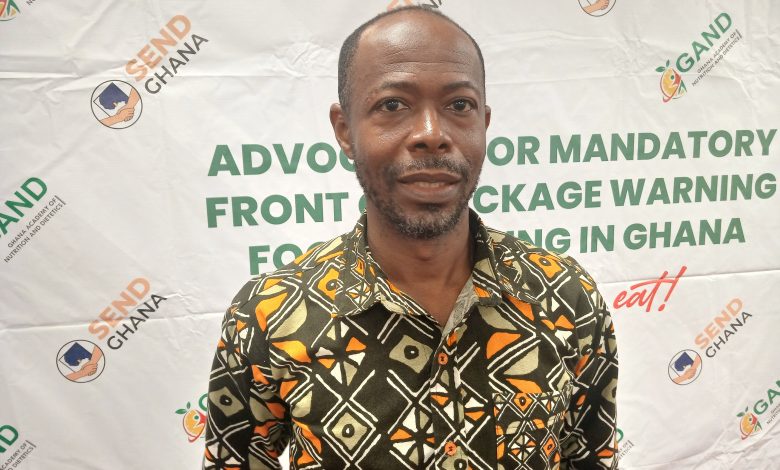
By Eugene Nyarko Jnr. | Accra City Hotel, Accra | Friday, June 26, 2026 —
Civil society organisations are intensifying calls for the introduction of mandatory Front-of-Pack Warning Food Labelling (FoPWL) in Ghana as part of efforts to curb the growing burden of non-communicable diseases (NCDs) in the country.
Speaking during an Editors’ Forum on Advocacy for Mandatory Front-of-Pack Warning Food Labelling organised by SEND Ghana and its partners, the Ghana Academy of Nutrition and Dietetics (GAND), at the Accra City Hotel in Accra, the Executive Director of Vision for Accelerated Sustainable Development (VAST) Ghana, Mr. Labram Musah, described the rising incidence of NCDs as a national health crisis requiring urgent action.
According to him, the COVID-19 pandemic exposed the vulnerability of persons living with underlying health conditions, many of whom suffered severe complications or died during the outbreak.
Mr. Musah noted that diseases such as diabetes, hypertension, cancers and respiratory ailments continue to rise despite receiving limited global funding compared to communicable diseases.
He attributed nearly 45 per cent of NCD cases to the consumption of unhealthy commodities, including ultra-processed foods and sugar-sweetened beverages.
“People should know what they consume. When consumers go to the shop to buy a product, they should easily know what is in it and make informed choices,” he stated.
Mr. Musah argued that manufacturers should be transparent about the nutritional content of their products, especially where sugar, salt and fat levels exceed recommended thresholds established by the World Health Organisation (WHO).
He explained that front-of-pack warning labels would provide consumers with simple and clear information, enabling them to identify products that are high in sugar, salt, fat or calories before purchase.
Drawing parallels with tobacco products, Mr. Musah said warning labels on cigarettes have helped consumers understand the health risks associated with smoking and that a similar approach should be adopted for unhealthy food products.
He acknowledged that the introduction of warning labels could initially affect some businesses but maintained that, in the long term, industries would be encouraged to adopt a total shift to healthy products and prioritise public health.
Mr. Musah disclosed that approximately 94,400 people die annually from non-communicable diseases, stressing that NCDs have overtaken many other diseases as a leading cause of death.
He called on government, industry players, policymakers, the media and the public to support the campaign, insisting that all stakeholders must be held accountable in addressing the growing burden of NCDs.
“The target is everyone. We are engaging the media, policymakers, the Food and Drugs Authority, the Ministry of Health, Parliament and citizens because the impact affects all of us,” he said.
Also speaking at the forum, Ms. Levlyn Konadu Asiedu of SEND Ghana said Ghana currently lacks a mandatory front-of-pack warning labelling policy, while nutrition labelling on the back of food packages also remains voluntary.

She explained that under the proposed policy, manufacturers would be required to place warning labels on products that exceed acceptable levels of critical nutrients such as sugar, salt and fats.
Ms. Asiedu noted that the advocacy campaign is targeting highly processed foods, including biscuits, fizzy drinks, noodles and canned products, rather than minimally processed local foods.
She said the objective is to empower consumers to make informed dietary choices and reduce their risk of developing chronic illnesses such as diabetes and hypertension.
According to her, SEND Ghana is engaging a broad range of stakeholders, including policymakers, academia, parents, students, health professionals, insurance groups and community members to build support for the policy.
Ms. Asiedu stressed that the organisation would continue its advocacy until the policy is implemented and citizens across the country become fully aware of the warning labels.
“Our goal is to ensure that even the last-mile community member understands the warning labels and is able to make informed choices. We are going all the way to getting this done,” she added.