
XCLUSIVE 9JA SPECIAL FEATURE
By the time Nigerians step into polling units again in 2027, they won’t just be choosing a president — they’ll be delivering a verdict.
A verdict on hardship.
On reform.
On trust.
On whether power consolidates or fractures.
When Independent National Electoral Commission (INEC) declared Bola Ahmed Tinubu winner of the February 25, 2023 presidential election with 8,794,726 votes (36.61%), the result revealed something deeper than victory margins. It exposed structural truths about Nigeria’s political arithmetic.
Voter turnout stood at roughly 29% — the lowest since Nigeria’s return to civilian rule in 1999. The opposition was split. The courts, including the Supreme Court of Nigeria, later affirmed the outcome, dismissing petitions challenging the result.
But 2023 was not the end of a contest. It was the opening chapter of 2027.
And the numbers still matter.
INCUMBENCY: POWERFUL, BUT NOT INVINCIBLE
Since 1999, no incumbent president seeking re-election has lost in Nigeria. Incumbency is the strongest weapon in the country’s political arsenal.
But it is not magic. It is conditional.
On May 29, 2023, President Tinubu announced the removal of petrol subsidy — a policy previous administrations had delayed despite fiscal warnings from institutions like the World Bank. He also unified Nigeria’s multiple exchange windows, effectively liberalizing the naira.
The economic shock was immediate.
Data from the National Bureau of Statistics showed inflation climbing above 30% in 2024. Food inflation surged. Transport costs spiked. The naira depreciated sharply.
For millions of Nigerians, reform translated into reduced purchasing power.
Government officials insist the pain is transitional — a structural correction meant to stabilize public finances and attract long-term investment. They point to higher federal allocations to states and expanded social intervention schemes.
But elections are not won on macroeconomic theory.
They are decided at the market stall. At the fuel pump. At the dining table.
If inflation moderates and tangible improvements become visible before 2027, Tinubu’s “difficult but necessary decisions” narrative could crystallize into a re-election strategy. If hardship lingers, the opposition will frame the election as a referendum on economic pain.
THE OBI QUESTION: MOVEMENT OR MACHINE?
In 2023, Peter Obi did more than run for president — he disrupted Nigeria’s political vocabulary.
Under the banner of the Labour Party, long considered marginal, Obi secured 6,101,533 votes (25.40%) and won the Federal Capital Territory — a symbolic milestone.
His base was youthful, urban, digitally mobilized, volunteer-driven.
But structure matters.
The Labour Party lacked entrenched rural networks in many northern states. In Kano, the local dominance of the New Nigeria Peoples Party overshadowed Labour’s presence. In several northern strongholds, Obi’s vote share remained minimal.
The core question for 2027 is strategic:
Can a movement convert enthusiasm into nationwide machinery?
Can digital energy translate into booth-level protection?
Can volunteerism evolve into coalition politics?
In 2023, momentum disrupted.
In 2027, structure may decide.
ATIKU, KWANKWASO & THE MATH OF DIVISION
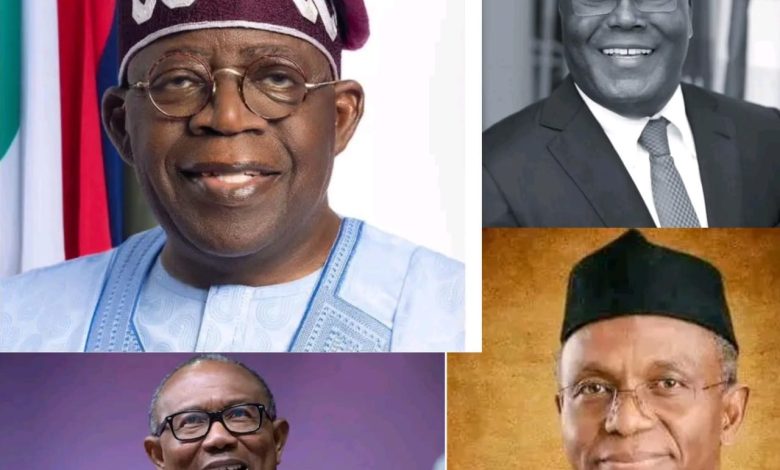
Atiku Abubakar remains one of Nigeria’s most persistent presidential contenders. In 2023, he secured 6,984,520 votes (29.07%), finishing second. His strength remained concentrated in northern states and traditional PDP zones.
Meanwhile, Rabiu Musa Kwankwaso polled 1,496,687 votes — largely concentrated in Kano, one of Nigeria’s most decisive electoral blocs.
Here is the critical statistic:
The combined votes of Atiku, Obi, and Kwankwaso exceeded Tinubu’s total.
Fragmentation was not philosophical.
It was numerical.
Had consolidation occurred, even partially, the 2023 map would have looked dramatically different.
For 2027, the arithmetic is blunt:
- A divided opposition simplifies the incumbent’s path.
- A unified ticket complicates it.
Ambition, ideology, ego, regional balance — all must negotiate with mathematics.
THE NORTHERN VARIABLE & ELITE SIGNALS
No presidential pathway exists without substantial northern support. The northwest alone accounts for millions of votes.
Political observers are closely watching influential northern actors like Nasir El-Rufai. Though not a 2023 candidate, his post-election repositioning and public critiques suggest shifting elite alignments.
Nigeria’s political history shows elite fractures often precede structural change. In 2013, defections from the ruling party catalyzed the coalition that unseated an incumbent in 2015.
In Nigeria, alliances shift quietly before they shift publicly.
2026 may be louder than 2025.
TECHNOLOGY, TRUST & THE 29% PROBLEM
The 2023 election also tested electoral technology. INEC deployed the Bimodal Voter Accreditation System (BVAS) and promised electronic result transmission via the IReV portal.
While accreditation functioned widely, delays in uploading presidential results triggered controversy. The courts ruled real-time transmission was not legally mandatory.
But legality and legitimacy are not always the same in public perception.
Turnout in 2023 was historically low. Millions of registered voters stayed home.
If economic dissatisfaction or opposition mobilization drives turnout upward in 2027 — even modestly — the electoral equation shifts.
Nigeria’s median age is under 20. The youth vote remains both energized and unpredictable.
Online activism is loud.
But ballots are quieter — and decisive.
2027: REFERENDUM OR ROUTINE?
The next election will not simply replay 2023 rivalries.
It will test:
- Whether economic reform yields visible dividends.
- Whether opposition leaders can subordinate ambition to coalition.
- Whether electoral institutions rebuild trust.
- Whether voters believe participation changes outcomes.
If inflation declines and growth stabilizes, the incumbent campaigns on resilience.
If hardship persists, the ballot becomes protest.
If opposition leaders fragment again, continuity becomes mathematically probable.
If they unite, Nigeria faces a genuine referendum.
THE BOTTOM LINE
2023 was defined by fragmentation.
2027 may be defined by consolidation — or its failure.
Nigeria’s democracy has matured beyond personality politics alone. Structure, arithmetic, lived experience, and elite negotiation now outweigh rhetoric.
The road to 2027 is already under construction.
And this time, the numbers may matter even more than the noise.
ICN-GHANA l XCLUSIVE 9JA