
By Eugene Nyarko Jnr. l MinCom Headquarters, Accra l April 27, 2026
The Government has revoked the Akango, Salman and Nkroful mining leases of Adamus Resources Limited following what authorities describe as serious and deliberate breaches of Ghana’s mining laws.
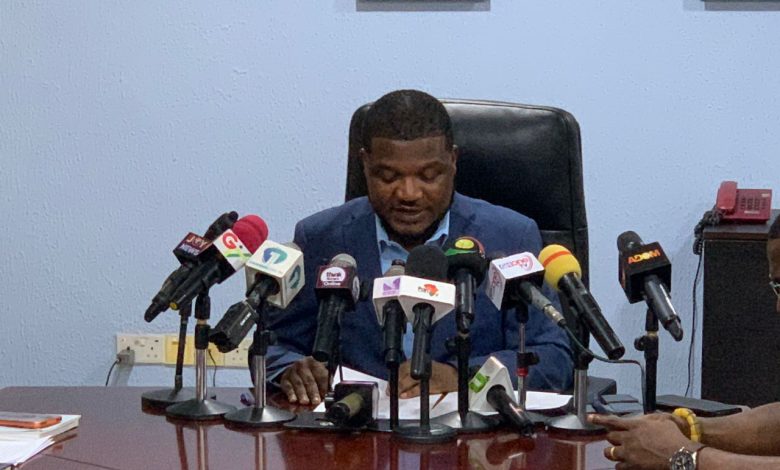
The decision, announced by the Minister for Lands and Natural Resources, Emmanuel Armah-Kofi Buah, was explained at a press conference held at the Minerals Commission headquarters in Accra by the Chief Executive Officer of the Minerals Commission, Isaac Tandoh.
According to Mr. Tandoh, investigations conducted by the Commission’s Inspectorate Division revealed that Adamus Resources Limited unlawfully assigned portions of its mineral rights to third parties without obtaining prior ministerial approval, in violation of Section 14 of the Minerals and Mining Act, 2006 (Act 703).
He disclosed that the company had also released three concession areas—Nkroful, Akango and Salman—for mining activities outside its approved operational zones and without access to its processing infrastructure. Additionally, no proven mineral reserves had been established in these areas to justify legitimate mining operations.
The Commission further observed active mining preparations at the Akango and Salman concessions without approved operational plans or permits from the Chief Inspector of Mines. Equipment including excavators and bulldozers were found on site undertaking earthworks.
Mr. Tandoh revealed that foreign nationals, particularly Chinese operators, were engaged in illegal mining activities—commonly known as “galamsey”—at sites located several kilometres away from the company’s official infrastructure, in contravention of provisions under the Minerals and Mining (Amendment) Act, 2019 (Act 995).
He noted that these activities were not only unlawful but environmentally destructive, causing land degradation, threatening water bodies and posing public health risks due to the use of unregulated chemicals. The operations, he added, also deprived the state of legitimate mining revenue.
Based on the findings, the Minerals Commission recommended the immediate revocation of the leases and the prosecution of the company and its directors. Mr. Tandoh emphasised that while the law generally allows a notice period to rectify breaches, the severity and deliberate nature of the violations justified swift action in the interest of environmental protection and public safety.
“The decision was neither arbitrary nor politically motivated. It was a lawful, evidence-based action to protect Ghana’s natural resources and uphold the integrity of our mining laws,” he stated.
He stressed that the revocation serves as a strong warning to mining firms that illegal activities will not be tolerated under the guise of investment. He added that the Commission would work with the Ministry to safeguard jobs affected by the decision and announce transitional measures in due course.
Mr. Tandoh also reiterated government policy encouraging greater participation of indigenous Ghanaian companies in mining operations, particularly in contract mining. He explained that existing regulations require such operations to be undertaken by Ghanaian-owned firms or in partnership arrangements that ensure at least 50 percent local participation in underground mining.
He noted that these provisions, incorporated into the Local Procurement List in January 2025, have already been successfully adopted by several multinational mining companies operating in the country.
The Minerals Commission, he said, remains committed to strict enforcement of mining regulations through unannounced inspections, prosecution of offenders and cancellation of licences where necessary.
“Ghana welcomes responsible investment, but the era of impunity—where leases are used to facilitate illegal mining and unauthorised foreign participation—is over,” he added.