

Story by Eugene Nyarko Jnr. l Accra l Thursday, November 19, 2026 —
Social Enterprise Ghana (SE Ghana) has unveiled three major initiatives, including the Ghana Social Enterprise Academy, a proposed Ghana Social Enterprise Policy and the Ghana Social Enterprise Fund, as part of efforts to strengthen the country’s social enterprise ecosystem and accelerate inclusive economic development over the next decade.
The initiatives were announced during the launch of the organisation’s 10th Anniversary celebration, dubbed the Ghana Social Enterprise Forum 2026, held at the British Council in Accra on Thursday, November 19, 2026, under the theme: “Celebrating a Decade of Impact: Building a Generational Legacy for Shared Prosperity.”
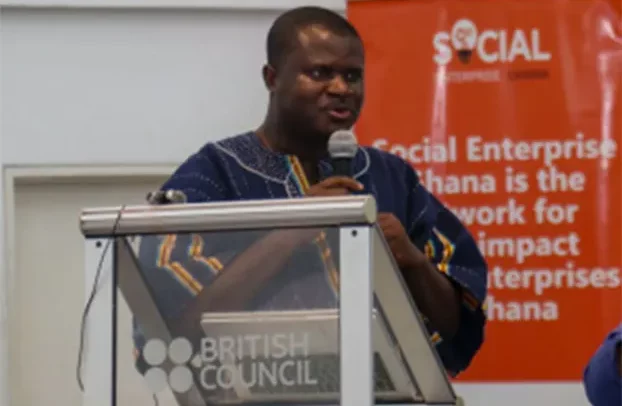
Speaking during a media interaction, Executive Director of Social Enterprise Ghana, Edwin Zu-Cudjoe, said the organisation had, over the past decade, trained more than 60,000 social businesses across the country, while estimating that approximately 200,000 social enterprises were operating in various communities and contributing to social and economic development.

He explained that the Ghana Social Enterprise Academy would provide a dedicated physical space and platform for young entrepreneurs to acquire relevant skills, incubate business ideas, access capacity-building opportunities and develop sustainable enterprises capable of generating meaningful economic and social impact.
According to him, the academy was conceived in response to the persistent challenge of securing suitable and regular spaces for training, meetings and other capacity-development activities for social entrepreneurs.
Mr Zu-Cudjoe said although the financial value of establishing the academy had not yet been disclosed, the organisation had received encouraging commitments from strategic partners and was calling on other stakeholders within the enterprise ecosystem to support the initiative.
He further identified the proposed Ghana Social Enterprise Policy as another critical instrument for advancing the sector, explaining that the policy, which has seven thematic areas, seeks to establish a legal and institutional framework that recognises, protects and supports social enterprises to thrive.
He stressed that the growing number of social enterprises across Ghana required appropriate recognition and a supportive business environment to enable them to expand their operations and sustain their contributions to national development.
The third initiative, the Ghana Social Enterprise Fund, is expected to address one of the major challenges confronting start-ups and small social businesses: limited access to finance and investment opportunities.
Mr Zu-Cudjoe said the fund would provide patient and catalytic capital to support enterprises, particularly women-led businesses and those operating in the green economy, to overcome financial constraints and scale up their operations.
He disclosed that Social Enterprise Ghana had already invested in approximately 1,200 social businesses over the past 10 years, adding that the three initiatives would serve as major springboards for the organisation’s next decade of work.
He consequently called on government, development partners, impact investors and other ecosystem players to help create a business-friendly environment that gives smaller and green enterprises equal opportunities to benefit from national economic initiatives.
He mentioned programmes such as the Big Push, the 1 Million Coders initiative, the 24-Hour Economy and the New Economy, urging government to ensure that their benefits extended beyond large and traditional businesses to include smaller enterprises that require training, investment and other forms of support to grow.
Addressing aspiring social entrepreneurs, Mr Zu-Cudjoe encouraged them to join the social enterprise community and use their businesses not only to generate profits but also as instruments for social change and economic transformation.
He said membership of the network would provide entrepreneurs with access to training, mentorship, business connections, advocacy and opportunities to attract investment.
He identified the lack of suitable training facilities and the absence of long-term strategic partnerships as some of the major challenges confronting social enterprises, stressing that sustainable collaboration with government agencies and impact investors was necessary to ensure consistency in the support provided to entrepreneurs.
Board Chairperson highlights decade of impact
For her part, Board Chairperson of Social Enterprise Ghana, Amma Serwaa Sefa Dedeh Lartey, said the organisation was established 10 years ago at the same venue, bringing together 20 organisations committed to building a collaborative and sustainable social enterprise sector in Ghana.

She explained that social enterprises were businesses that pursued financial returns while deliberately creating positive social and environmental impacts.
Such enterprises, she noted, included businesses that protect the environment, create employment for young people and persons with disabilities, support rural communities and urban slums, and provide solutions to social challenges such as access to healthcare.
Mrs Lartey said the organisation had supported more than 80,000 businesses over the past decade through training, start-up support, networking opportunities and other interventions aimed at helping entrepreneurs establish and expand their businesses.
She also announced the launch of the Social Enterprise Academy, describing it as a physical facility that would provide essential amenities and opportunities for entrepreneurs to train, establish and grow their businesses.
Although details regarding the academy’s location and facilities were not fully disclosed at the launch, she assured stakeholders that the organisation would provide further information at the appropriate time, indicating that initial partners had already supported the initiative.
Looking ahead, Mrs Lartey said the organisation intended to expand its impact from tens of thousands of beneficiaries to hundreds of thousands, with the broader ambition of encouraging every business in Ghana to embrace social and environmental responsibility alongside profitability.
She explained that such an approach would help build a society where economic opportunities and prosperity were shared, irrespective of people’s abilities or access to resources.
On the impact of the organisation’s interventions, she said its training programmes had helped beneficiaries establish businesses, generate income and contribute positively to their communities.
She cited sustainable agriculture, agroforestry and recycling as examples of activities through which social enterprises were creating economic opportunities while protecting the environment.
Mrs Lartey added that the organisation monitored beneficiaries at different stages during and after training, with some programmes extending over five years to enable it to assess business growth and the long-term impact of their activities on surrounding communities.
She also encouraged interested social enterprises to join the organisation’s network through its website, www.segana.net, where prospective members could complete an application process.
The 10th Anniversary celebration marks a significant milestone in Social Enterprise Ghana’s efforts to promote entrepreneurship that combines business sustainability with social responsibility and environmental protection, as it positions itself to deepen its contribution to Ghana’s inclusive and sustainable economic development.