
Accra, October 21, 2025:
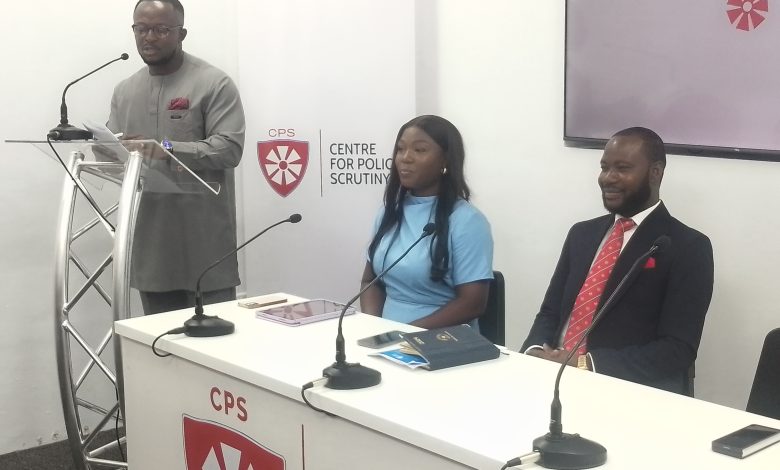
The Center for Policy Scrutiny (CPS) has called for greater coherence, institutional discipline, and fiscal realism in the implementation of Ghana’s 24-hour economy policy. This came during the presentation of a review paper titled “Ghana’s 24-Hour Economy and Accelerated Export Development Program: A Critical Review” held at the CPS Office in Kokomlemle, Accra.
In her opening remarks, Stephanie Anokyewa Tawiah, Head of Programs at CPS, said the initiative presents an ambitious and timely attempt to reimagine Ghana’s economic architecture by extending productive hours, unlocking latent capacity, and promoting inclusive growth.
“Ambition alone is not enough. Effective program design and delivery require coherence, realism and institutional discipline,” she cautioned. “This review is not just a technical exercise but an invitation to dialogue. Building a resilient, job-rich and diversified economy is a collective mandate,” she added.
Highlights of the CPS Review
Presenting the review paper, Dr. Adu Owusu Sarkodie, Executive Director of CPS, explained that the 24-hour economy program—launched on July 2, 2025—aims to transform Ghana’s economy from a raw material exporter into a value-added, industrialized one.
The program, he said, is structured around eight sub-programs—Growth24 (agriculture), Make24 (manufacturing), Build24 (construction), Show24 (creative arts and tourism), Connect24 (logistics), Finance24 (funding), Asfar24 (human capital), and Goal24 (public mobilization)—anchored on three pillars: production transformation, supply chain efficiency, and human capital development.
Dr. Sarkodie clarified misconceptions about the initiative, emphasizing that the 24-hour economy is not simply about a three-shift employment system, but rather a broader national transformation agenda aimed at driving industrial productivity and export competitiveness.
He outlined nine critical observations from the CPS analysis, including:
- The program accurately diagnoses Ghana’s development challenges but must avoid duplicating existing initiatives.
- Its comprehensive and cross-sectoral nature is commendable but requires stronger alignment with the National Development Planning Commission (NDPC) for coherence and budgetary integration.
- The Volta Basin Economic Corridor remains the “flagship of the flagship,” with significant potential to spur industrial activity in the country’s middle and northern belts.
- Agro-industrialization is rightly prioritized, but fiscal and implementation risks remain due to inadequate project appraisals.
- The program’s cost, estimated at USD 4 billion, may be underestimated as indirect costs and tax incentives have not been fully accounted for.
Key Recommendations
The CPS report proposed that government should:
1. Integrate the 24-hour economy into Ghana’s Medium-Term Development Framework, led by the NDPC.
2. Publish detailed cost estimates and adopt phased fiscal planning to promote transparency.
3. Undertake rigorous appraisals of major projects to ensure value for money.
4. Align infrastructure ambitions with realistic public investment commitments.
5. Design targeted tax incentives linked to productivity and employment outcomes.
6. Institutionalize learning from past national development plans to avoid repeated policy failures.
Secretariat’s Response
Reacting to the presentation, Dr. Ishmael Nii Dodoo, Director and Head of Partnership and Marketing at the 24-Hour Economy Secretariat, described the CPS review as a constructive and insightful contribution to national discourse.
He noted that the Secretariat is already working with the NDPC to ensure policy alignment with Ghana’s multi-year development plans and stressed the importance of private sector participation.
“Our focus is on making the projects bankable and mobilizing industries that can expand through the 24-hour economy,” Dr. Dodoo stated. “We are currently working on nine strategic projects—most within the Volta Economic Corridor—and have secured a $500 million SME facility through BADEA to support enterprise financing.”
He encouraged Ghanaian youth and entrepreneurs to submit their business proposals via the Secretariat’s platform, enterprise24h+.gov.gh, for potential inclusion in the national program.
Conclusion
The CPS forum concluded with a call for constructive engagement among policymakers, academia, civil society, and the private sector to ensure the 24-hour economy initiative delivers on its promise of job creation, industrial diversification, and sustainable economic transformation.
Story by Eugene Nyarko Jnr.