
Story by Eugene Nyarko Jnr. | NPP Headquarters, Accra | April 7, 2026
The opposition New Patriotic Party (NPP) has accused President John Dramani Mahama and the governing National Democratic Congress (NDC) of engaging in “political deceit, hypocrisy, and double standards” over the handling of the Human Sexual Rights and Family Values Bill.
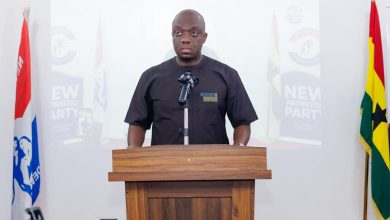
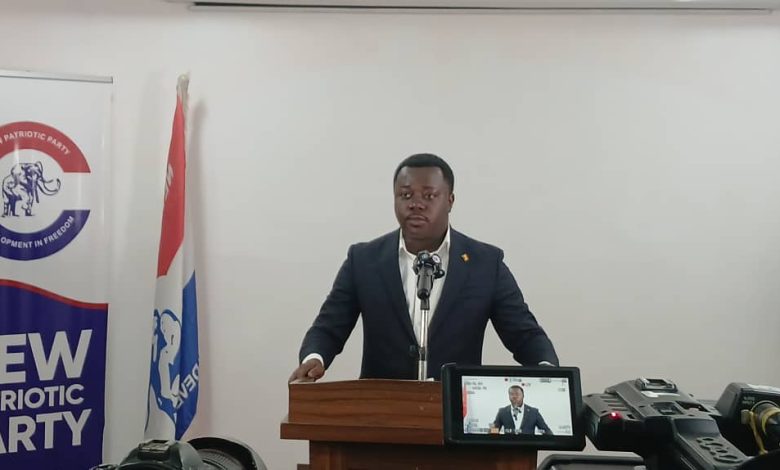
Addressing a press conference in Accra on Tuesday, Assin South Member of Parliament, Rev. John Ntim Fordjour, criticised the NDC for what he described as a sharp shift in position on the controversial legislation after assuming power.
According to him, the NDC had strongly supported the bill while in opposition, only to retreat from that stance upon returning to government in 2025.
“We have called you here today to address a matter of grave national importance—a matter that exposes the highest order of political deceit, hypocrisy, and double standards,” Rev. Fordjour stated.
Shift in position
Tracing the origins of the bill to 2021, Rev. Fordjour noted that it was sponsored by lawmakers from both major political parties, including members of the NDC. He said the NDC at the time adopted a firm and assertive posture, engaging various stakeholders including the media, religious leaders, and traditional authorities to push for its passage.
He further recalled that during the 2024 general election campaign, President Mahama pledged to sign the bill into law, presenting himself as a strong defender of Ghanaian family values.
However, the NPP contends that the government’s position has since changed. Rev. Fordjour cited engagements between President Mahama and religious leaders, including the Ghana Catholic Bishops’ Conference, where the President suggested that a new government-sponsored bill would be more appropriate following the expiration of the previous Parliament.
At the time, the President reportedly argued that the legislation would be better pursued as a government bill after broader stakeholder consultations.
‘Not a priority’ comment
The controversy deepened after President Mahama reportedly stated on March 31 that his administration was focused on addressing “basic needs,” indicating that the bill was not an immediate priority.
Rev. Fordjour questioned the shift, asking whether those same needs did not exist between 2021 and 2024 when, he claimed, the issue was actively used for political advantage.
“To advocate so aggressively for a policy in opposition, only to dismiss it as a low priority once in government, is the height of hypocrisy,” he said.
Curriculum concerns
The NPP also raised concerns about developments in the education sector, referencing a recent issue involving teaching materials. The National Council for Curriculum and Assessment (NaCCA) had earlier acknowledged the inclusion of contested definitions in a teacher’s manual, describing it as an anomaly.
Rev. Fordjour, however, alleged contradictions with earlier assurances by the President, accusing the government of using the curriculum to subtly promote ideas contrary to Ghanaian values.
Questions over silence
The party further questioned what it described as the silence of some NDC figures who had previously championed the bill in Parliament but are now serving in government.
Rev. Fordjour suggested that their reduced advocacy indicates that their earlier support for the bill may have been politically motivated rather than based on principle.
“For these NDC ministers, the bill was never about an ideological commitment… it was merely a strategic vehicle to ride back into the Jubilee House,” he claimed.
Calls for clarity
The NPP has called on President Mahama to clearly state his position on the bill.
“He must state unequivocally whether he intends to sign the bill… without hiding behind excuses of ‘basic needs’ or procedural preferences,” Rev. Fordjour said.
The party also urged religious bodies and civil society organisations to hold the government accountable, while calling on Parliament to expedite the reintroduction and passage of the bill.
Ongoing debate
The Human Sexual Rights and Family Values Bill remains one of the most contentious legislative issues in Ghana, attracting strong support from religious and cultural groups, while also drawing criticism over potential human rights implications and possible international repercussions.
With pressure mounting from multiple stakeholders, the Mahama administration is expected to face continued scrutiny over its handling of the matter.