
Ghana Water Inaugurates 10 Revenue Enhancement Teams to Tackle Losses, Boost Sustainability

Story by Eugene Nyarko Jnr. I Accra l Wednesday, February 4, 2026
The Managing Director of Ghana Water Limited (GWL), Hon. Adam Mutawakilu, has inaugurated 10 Revenue Enhancement Teams nationwide as part of decisive measures to strengthen the company’s finances, curb illegal water connections and improve service delivery.
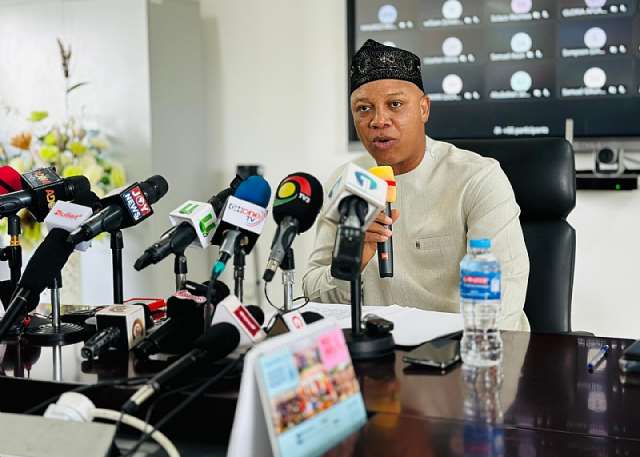
Speaking at a press conference at GWL’s national headquarters in Accra, Hon. Mutawakilu described the inauguration as a “turning point” in the transformation of the utility, stressing that sustainable revenue is critical to delivering reliable and affordable potable water to Ghanaians.
He noted that while water is a social good, its production and distribution remain capital-intensive, requiring continuous investment in chemicals, electricity, infrastructure and skilled personnel. “Without sound revenue, there can be no sustainable service,” he stated.
Rising Costs, Aging Infrastructure
The Managing Director outlined key operational and financial challenges confronting the company, including escalating operational costs, aging transmission and distribution infrastructure, production constraints and growing customer indebtedness.
According to him, national daily water demand stands at about 350 million gallons, while existing treatment plants can produce only 220 million gallons, leaving a deficit of 130 million gallons daily. In the Accra–Tema Metropolitan Area alone, demand is estimated at 210 million gallons per day against a supply of 137 million gallons, resulting in a shortfall of 73 million gallons.
He added that outstanding arrears running into billions of cedis continue to weaken GWL’s cash flow and limit its ability to maintain infrastructure, procure inputs and expand services.
Non-Revenue Water at 52%
Hon. Mutawakilu expressed concern over the high level of Non-Revenue Water (NRW), which stood at 52 per cent as of December 2024. This means that nationally, out of 220 million gallons of water supplied daily, 114 million gallons are unaccounted for.
He explained that technical losses account for about 22 per cent of NRW due to leakages and bursts, while commercial losses — estimated at 78 per cent — arise from illegal connections, meter bypassing, billing anomalies and water theft.
Early Gains from Enforcement
To address commercial losses, GWL established three Revenue Enhancement Teams in August 2025. Their operations have uncovered 239 illegal connections and led to charges totaling GH¢8.6 million, with GH¢2.1 million recovered so far.
Encouraged by these results, management has increased the number of teams to 10, adding seven new units to operate across the country.
Mandate of the Teams
The Revenue Enhancement Teams will focus on improving revenue collection, reducing customer indebtedness, detecting and regularizing illegal connections, verifying meters, correcting billing anomalies and supporting efforts to reduce Non-Revenue Water. They will also engage customers to encourage voluntary compliance and strengthen accountability.
“These are not punitive teams,” Hon. Mutawakilu emphasized. “They are corrective, protective and supportive. We seek compliance, not confrontation.”
Digital Convenience and Call to Action
He highlighted GWL’s ongoing digital transformation, which allows customers to pay bills through mobile money, bank apps and USSD platforms, receive bills via SMS and email, and access support through call centres and social media.
The Managing Director appealed to customers to pay their water bills promptly, noting that every cedi collected goes into chemicals, electricity, maintenance, pipe replacement, network expansion and service improvement.
Concluding, Hon. Mutawakilu said the inauguration marked the beginning of a new chapter defined by accountability, efficiency and service excellence. He officially inaugurated the Revenue Enhancement Teams and called for collective responsibility to ensure a financially strong and resilient Ghana Water Limited.
“Together, we will deliver safe water to every Ghanaian, today and for generations to come,” he said.