
Accra – The Ministry of Lands and Natural Resources has reaffirmed government’s unwavering commitment to ending illegal mining, popularly known as galamsey, with a renewed focus on transparency, stakeholder collaboration, and enforcement.
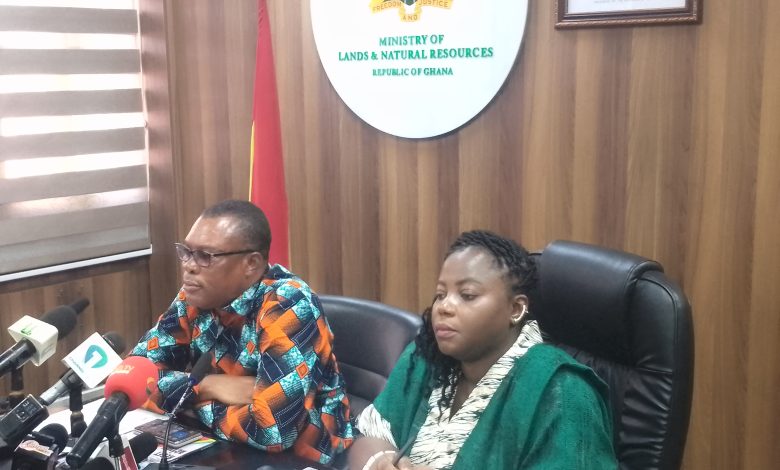
Addressing journalists at a press briefing in Accra, the Director of Communications at the Ministry, Ama Mawusi, outlined key updates on the government’s multi-pronged strategy to combat illegal mining and protect the nation’s environment, forest reserves, and water bodies.
According to her, while small-scale mining remains a vital contributor to Ghana’s economy, the associated illegalities continue to destroy farmlands, forests, and water resources, posing severe threats to public health and agriculture.
“We’re seeing the destruction of our forest reserves and water bodies. The implications are evident in our health and agriculture. That is why we must act decisively and transparently with the people of Ghana,” she said.
Mawusi noted that the Ministry has implemented a comprehensive anti-galamsey strategy that draws lessons from past efforts, incorporates global best practices, and emphasizes innovation for the future. The approach includes extensive stakeholder engagements, policy and regulatory reviews, law enforcement actions, and the creation of sustainable livelihood alternatives for individuals affected by the clampdowns.
Ongoing Enforcement and Operations
The Ministry’s operational arm, the National Anti-Illegal Mining Operations Secretariat (NAIMOS)—an inter-agency task force comprising the Police, Army, National Intelligence Bureau (NIB), and NACOB—has intensified operations in several regions.
Recent field activities have focused on areas in the Eastern and Western Regions, including Oda Nkwanta, Asamankese, and Wasa Agona, where illegal mining camps and makeshift settlements were dismantled.
During these operations, NAIMOS impounded and destroyed illegal mining equipment, including 24 pumping machines, 20 ‘chang fan’ dredging machines, four excavator batteries, and several motorbikes and fuel drums. Three individuals were arrested at Old Abirem for their involvement in illegal mining activities.
Mawusi also revealed that some confiscated items, such as water pumps, have been repurposed and handed over to the Ministry of Food and Agriculture for distribution to farmers, ensuring they are put to productive use.
Tracking and Regulation of Excavators
As part of efforts to control mining equipment, the Ministry has begun a nationwide registration and tracking exercise for excavators. Over 1,200 excavators have already been tracked and geo-fenced, allowing authorities to monitor their movement and usage in real time.
“Before anyone imports an excavator, they must obtain a permit specifying the purpose and location of use. Any excavator found operating outside its approved jurisdiction can be immobilized and confiscated,” Mawusi explained.
She added that the Ministry is working closely with the Ministry of Transport, the Ghana Revenue Authority (GRA), and the DVLA to identify unregistered excavators already in the system. Unclaimed or untraceable machines will be deemed state property.
Environmental Restoration Efforts
Beyond enforcement, the Ministry is pursuing environmental recovery through initiatives such as Tree for Life and Blue Water, aimed at reforestation and the de-chemicalization of polluted water bodies.
Mawusi emphasized the role of the media and the public in sustaining the national effort, urging all citizens to support the fight through education, vigilance, and responsible advocacy.
“Government is unwavering in its commitment to this cause. But this is not a fight for government alone — we are in this together as Ghanaians,” she stressed.
The Ministry pledged to continue providing periodic updates to the public as operations progress and new measures are rolled out to protect Ghana’s natural resources and secure sustainable livelihoods for affected communities.
Story by Eugene Nyarko Jnr.